
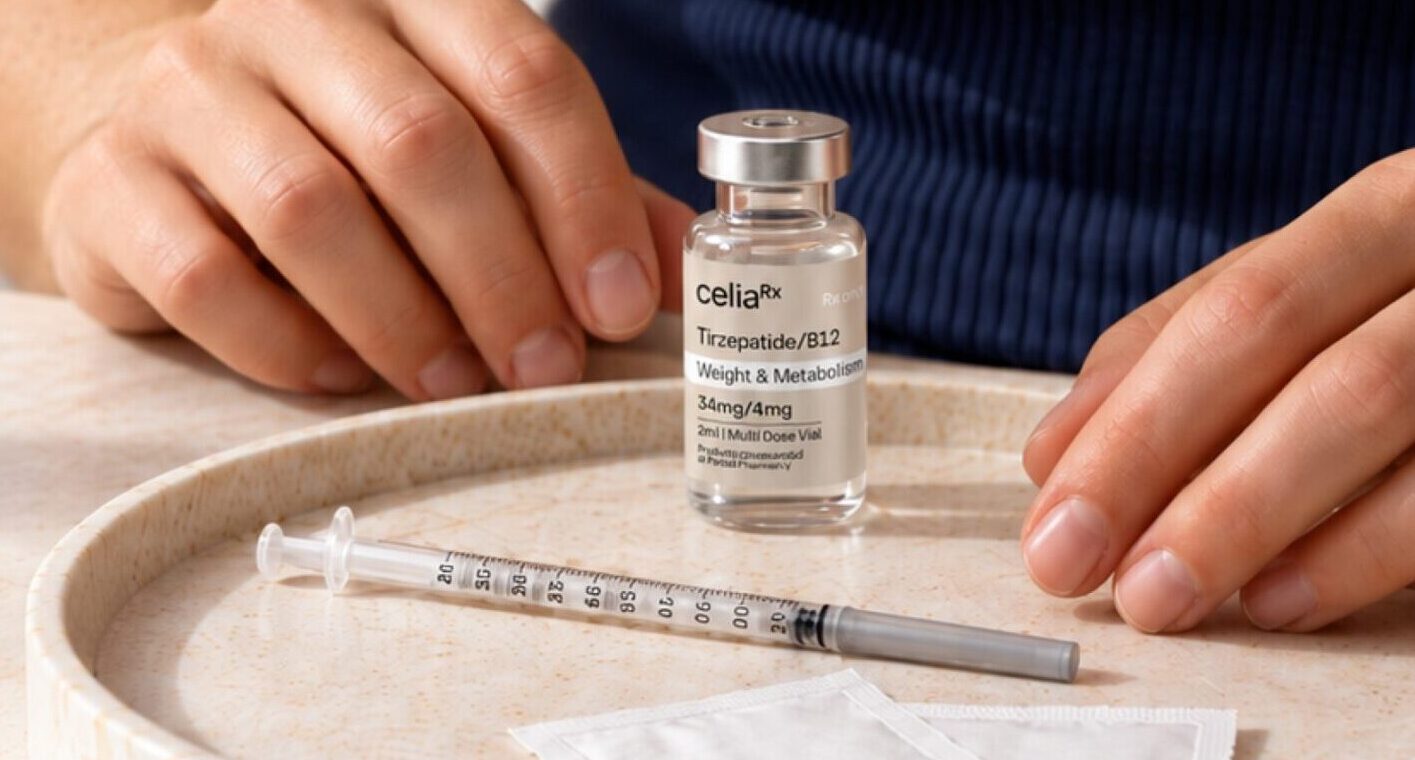
Interest in injectable medications keeps growing. A 2026 Gallup survey of U.S. adults (conducted May 28 to June 5) found that 11% currently take a GLP-1 medication for weight loss, up from 3% in 2024, and that 19% of current users take a compounded or custom-mixed version. Many people prescribed an injectable for the first time then search for how to inject tirzepatide at home.
This guide covers what you can reasonably know in advance: the supplies involved, how injection areas are described, what to watch for, and which details have to come from your own clinician and pharmacy.
What You Need Before Injecting
Patient materials for injectable medications generally list the same basics: the medication exactly as dispensed, the syringe or device your prescription specifies, alcohol swabs, a sharps container, and a clean, flat surface. For compounded products, the form (vial, pen, or another device) and the supplies that go with it depend on the dispensing pharmacy, so the paperwork with your order is the reference.
Check the label for your name, the product name, and the expiry date. Contact your clinician or pharmacy if anything is unclear or the product looks different from what was described.
Where to Inject Tirzepatide: How Sites Are Generally Described
Instructions for Use for FDA-approved tirzepatide (Zepbound) describe subcutaneous injection into the abdomen or thigh, and into the back of the upper arm when another person gives the injection. Your clinician decides what applies to your product.
| Area | How labeling describes it | General consideration |
| Abdomen | Stomach area. Labeling for approved products says you or another person can inject here. | Patient resources commonly describe it as the most accessible area for self-injection. |
| Thigh | Labeling for approved products says you or another person can inject here. | Usually described as the front or outer thigh. The inner thigh is generally avoided because of rubbing and irritation. |
| Back of upper arm | Labeling states that another person should give the injection here. | Hard to reach on your own, which is why a second person is described. |
The same labeling describes changing (rotating) the injection spot within the chosen area each time. The stated reason is to reduce the risk of lipodystrophy (pits in the skin or thickened skin) and localized cutaneous amyloidosis (lumps in the skin). It also says not to inject into a spot used for other medicines.
How to Inject Tirzepatide: What Your Clinician Will Walk You Through
Most patient instructions cover the same broad stages: hand hygiene and a clean space, preparing the medication as the product directions specify, choosing and cleaning the site, giving the injection, and disposing of used supplies in a sharps container.
The details inside each stage, including how the medication is prepared, the needle or device, the angle, and how long to hold, differ between pens and vials and between FDA-approved and compounded products. That is why Celia does not publish a one-size-fits-all technique here. Labeling for the approved product notes that a healthcare provider should show you how to use it before the first time, and the same expectation applies to any injectable: ask your clinician to review the written directions with you before your first use.
How to Inject Tirzepatide at Home: Safety and What to Watch For
Any injectable can cause local reactions. In SURMOUNT-5, an open-label Phase 3b trial in 751 adults with obesity or overweight and without diabetes, investigators reported more injection-site reactions in the tirzepatide group than in the semaglutide group. The open-label design is a limitation, since participants and investigators knew which drug was used.
Gastrointestinal effects are the most commonly reported adverse events in the SURMOUNT program. In SURMOUNT-1, a Phase 3 randomized controlled trial of 2,539 adults with obesity, or overweight with a weight-related condition, and without diabetes, about 80% of participants taking tirzepatide reported at least one adverse event, compared with 72% on placebo. At 72 weeks, mean body weight change alongside lifestyle intervention was -15.0%, -19.5%, and -20.9% across the three studied doses, versus -3.1% with placebo. These results come from FDA-approved tirzepatide, not compounded products, and individual response varies.
Labeling for the approved product also notes that severe stomach problems and gallbladder problems have been reported. Contact your clinician about redness, swelling, or pain at an injection site that gets worse, a lump or skin change that does not go away, or any symptom that concerns you. Seek emergency care for signs of a serious allergic reaction, such as swelling of the face, lips, or tongue, or trouble breathing.
Common Injection Mistakes and How to Avoid Them
- Using the same spot repeatedly. Labeling describes rotating the spot to reduce the risk of skin changes.
- Reusing syringes or needles. Labeling for approved vials says to use a new syringe and needle for each injection to reduce infection risk and blocked needles.
- Following directions meant for a different product. Pen and vial directions differ, and compounded products have their own handling requirements. Use the paperwork that came with your prescription.
- Attempting the back of the arm alone. Labeling says another person should give injections there.
- Skipping sharps disposal. Used needles and syringes belong in a sharps container, not loose in the trash.
- Guessing when something seems off. Questions about technique or unexpected reactions are what your clinician is there for.
What to Understand Before Starting Tirzepatide
Tirzepatide at Celia is a prescription compound dispensed by a licensed 503A pharmacy after a licensed clinician reviews your health history and decides whether it is appropriate. A prescription is required, and not everyone will be prescribed it.
Celia offers a tirzepatide-B12 injectable (34 mg/4 mg) and a tirzepatide-B12 injectable (68 mg/8 mg) as prescription compounds. These are not FDA-approved drugs, and they do not come with the manufacturer package insert and Instructions for Use that accompany approved products. That is why your Celia clinician and the directions from your dispensing pharmacy are the primary source for how your specific product is prepared and used.
Handling after delivery matters too. Read the tirzepatide storage guide for how storage is generally approached, and follow the label on your own product.
Questions about your protocol?Message your Celia clinician. Not a patient yet? Book a Consultation through Celia’s weight and metabolism consultation to see how a licensed clinician evaluates whether a prescription is appropriate for you. |
Frequently Asked Questions
How do you inject tirzepatide correctly?
Correct technique depends on your specific product, so follow the written directions from your prescribing clinician and dispensing pharmacy. Broadly, instructions cover hand hygiene, preparing the medication, choosing and cleaning a site, injecting, and disposing of supplies in a sharps container. Ask your clinician to walk you through the details before your first use.
Where on the body do you inject tirzepatide?
Labeling for FDA-approved tirzepatide describes the abdomen, the thigh, and the back of the upper arm, with another person giving injections in the arm. Rotating the exact spot is described as a way to reduce the risk of skin changes. Your clinician confirms what applies to your product.
How do you inject tirzepatide at home safely?
Safety practices in patient materials include using clean hands and supplies, using a new needle and syringe each time, rotating sites, disposing of sharps properly, and storing the medication as labeled. Contact your clinician if you notice a reaction that worsens or a symptom that concerns you.
What angle should you use to inject tirzepatide?
The angle depends on the needle or device in your prescription, so use the exact directions that came with your product rather than a general rule. Your Celia clinician can review this with you.
How often do you inject tirzepatide?
Frequency is set by your prescribing clinician as part of an individual plan. In SURMOUNT-1, FDA-approved tirzepatide was studied as a once-weekly injection with gradual dose changes. Compounded products and individual plans can differ, so follow your clinician’s directions.
What happens if you inject tirzepatide in the wrong place?
Do not try to self-diagnose. Pain, bleeding, a lump, or redness that persists or worsens at an injection site is worth reporting to your clinician, who can advise on next steps and review your technique with you.
